
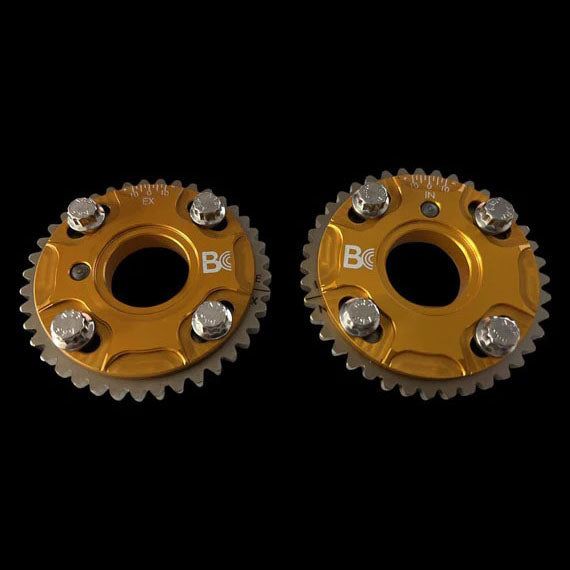
As a master performance mechanic and SEO expert, I present a definitive technical analysis of the BC8879 Adjustable Cam Gears, engineered by Brian Crower for the Can-Am Maverick X3 and its Rotax 900 powerplant. This pair of intake and exhaust cam gears, part number BC8879, is not merely an upgrade—it’s a precision instrument for redefining engine performance. In the realm of high-output UTVs, controlling valve timing is paramount for unlocking horsepower, sharpening throttle response, and tailoring the power band to specific terrain and modifications. This description delves into the metallurgy, design, compatibility, and tuning nuances of these components, providing the technical depth required by serious enthusiasts and builders to make informed, performance-driven decisions.
Engineering and Design Philosophy of BC8879 Cam Gears
The BC8879 Adjustable Cam Gears are a product of advanced motorsport engineering, designed to provide unparalleled control over the Rotax 900 engine’s valve train. Constructed from CNC-machined, high-grade billet aluminum, these gears offer exceptional strength-to-weight ratio, resisting deformation under high-RPM and thermal stresses common in turbocharged or aggressively tuned applications. The design incorporates precisely slotted adjustment holes, allowing for incremental cam timing changes typically in the range of ±5 degrees. Each gear features laser-etched degree markings for accurate reference, and a hardened steel insert is often used for the cam bolt interface to prevent wallowing and ensure consistent clamping force. The anodized finish not only provides corrosion resistance but also aids in heat dissipation. This attention to detail ensures that the gears maintain their setting integrity, a critical factor when precise valve events dictate power delivery and engine reliability.
Key Benefits of Upgrading to Adjustable Cam Gears
Installing the BC8879 Adjustable Cam Gears transforms the engine’s characteristics by allowing meticulous tuning of the camshaft position relative to the crankshaft. This capability yields several measurable performance advantages:
- Precise Power Band Tuning: Shift the engine’s torque curve to favor low-end grunt for technical crawling or high-RPM horsepower for desert racing, optimizing performance for specific disciplines.
- Maximized Volumetric Efficiency: Fine-tune valve overlap and timing to improve cylinder filling and scavenging, directly increasing horsepower and torque output across the RPM range.
- Enhanced Throttle Response: Correcting factory cam timing tolerances or compensating for aftermarket components results in immediate, linear throttle input, crucial for vehicle control.
- Compatibility with Engine Modifications: Essential for optimizing performance when paired with upgraded camshafts, ported heads, or forced induction systems, ensuring all components work in harmony.
- Durability and Reliability: The billet construction and robust design surpass OEM gears, offering peace of mind during extreme off-road use and high-stress competition environments.
- Correct for Manufacturing Tolerances: Account for slight variances in block, head, or timing chain wear, allowing for perfect timing alignment that OEM fixed gears cannot achieve.
Vehicle Fitment: Compatibility with Can-Am X3 and Rotax 900 Engines
The BC8879 Adjustable Cam Gears are meticulously designed for a specific application range, ensuring perfect fitment and function. This pair is engineered exclusively for the Rotax 900 ACE turbocharged three-cylinder engine found in the Can-Am Maverick X3 platform. Precise fitment includes, but is not limited to, the following models and model years, though always verify with the latest manufacturer data or vehicle VIN:
- Can-Am Maverick X3 DS Turbo: All model years from initial release (2017+) utilizing the Rotax 900 engine.
- Can-Am Maverick X3 MAX Turbo: All long-wheelbase variants across all production years.
- Can-Am Maverick X3 RS Turbo & RC Turbo: Including performance and closed-cab models.
- Engine Specific: Direct compatibility with the Rotax 900 ACE (1330cc) turbocharged engine, regardless of the Can-Am model trim. It is crucial to note that these gears are designed for the intake and exhaust camshafts on this specific engine architecture and are not interchangeable with other Rotax families or Can-Am models like the Commander or Maverick X3 with the 1000R engine.
For builders undertaking engine swaps or using the Rotax 900 in other applications, these gears can be adapted, but consultation with a performance mechanic is advised to confirm alignment with the timing cover and sensor triggers.
Technical Specifications and Design Analysis
Below is a detailed breakdown of the technical specifications for the BC8879 Adjustable Cam Gears, providing the hard data necessary for integration into any performance build or tuning plan.
| BC8879 Adjustable Cam Gear Technical Specifications | |
|---|---|
| Part Number | BC8879 |
| Application | Can-Am Maverick X3 (All Variants) with Rotax 900 ACE Turbo Engine |
| Gear Set | Pair (Intake and Exhaust) |
| Primary Material | CNC-Billet 6061-T6 Aluminum |
| Adjustment Range | ±5 Degrees of Cam Angle (Approximate, verifiable per installation) |
| Adjustment Increment | Approximately 1-2 degrees per slot movement |
| Hardware Interface | Hardened Steel Inserts for Cam Bolt |
| Surface Finish | Black Anodized (Corrosion & Wear Resistant) |
| Weight (Per Gear) | ~0.4 lbs (181 grams) – lighter than OEM for reduced rotational mass |
| Installation Hardware | High-grade mounting bolts typically included; always use thread locker. |
The design prioritizes a drop-in fit with OEM timing chains and sensors, requiring no modification to the engine block or head. The slotted design allows for movement while maintaining a large surface area for the cam bolt, ensuring secure clamping without risk of slippage.
Installation, Tuning, and Performance Optimization
Proper installation and tuning are critical to realizing the full potential of the BC8879 Adjustable Cam Gears. The process requires mechanical competency, a degree wheel or timing kit, and a dial indicator to measure camshaft lift accurately. Begin by setting the engine to top dead center (TDC) on the compression stroke for cylinder one. Replace the OEM gears with the adjustable units, initially setting them to the “zero” or stock timing position as a baseline. From here, the tuning begins. Advancing the cam timing generally improves low-end and mid-range torque, while retarding it can boost high-RPM horsepower. Small adjustments (1-2 degrees) have significant effects; it’s imperative to document changes and test performance systematically. For a foundational understanding of the principles at play, refer to this authoritative technical article on camshaft degreeing and timing principles from MotorTrend. After setting the desired timing, thoroughly secure the cam bolts with a calibrated torque wrench and high-quality thread locker. Final validation should involve checking valve-to-piston clearance, especially if aftermarket camshafts with higher lift are installed, to prevent catastrophic engine failure. Regular inspection of the timing chain tension and gear bolts during routine maintenance is advised to ensure long-term performance and reliability.
Be the first to review “BC8879 – NEW Can-Am Adjustable Cam Gears – Int/Exh (pair) for X3 / Rotax 900”
| Make | Model | Year |
|---|---|---|
| Polaris | Pro R | 2021 |
Related products
Reviews
There are no reviews yet.