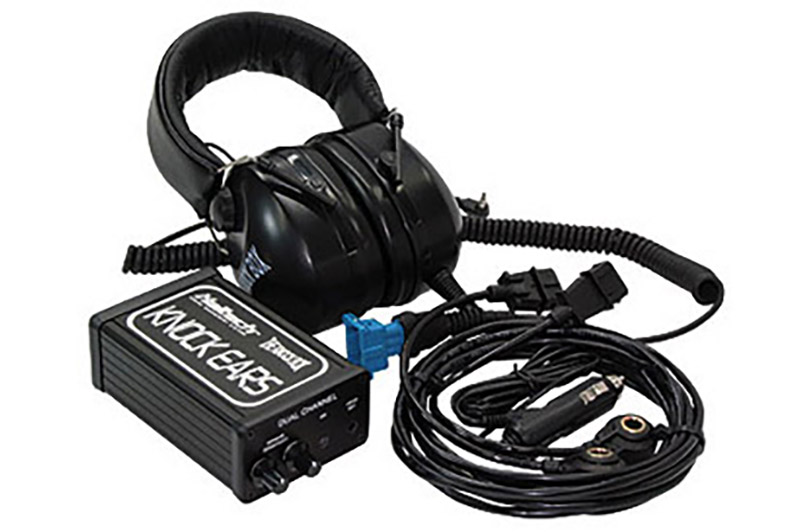
Professional Engine Calibration: The Dual-Channel Pro Tuner “Knock Ears” System
In the high-stakes environment of performance engine tuning, the ability to discern between safe combustion and destructive detonation is the difference between a championship-winning vehicle and a catastrophic mechanical failure. The Pro Tuner “Knock Ears” Kit Dual Channel 2014 Spec represents the industry benchmark for acoustic knock monitoring. Unlike factory knock sensors that rely on a generic signal processed by a filtered ECU algorithm, this dual-channel kit provides the tuner with a direct, high-fidelity window into the combustion chamber. This system is designed for the professional calibration engineer who requires laboratory-grade precision when defining the knock threshold across a fuel map calibration. By isolating engine-specific harmonics, this kit ensures that every degree of ignition timing is backed by empirical acoustic data.
The Engineering of Piezoelectric Acoustic Monitoring
Knock monitoring at this level relies on Piezoelectric theory. The kit utilizes two high-sensitivity wide-band knock sensors that convert mechanical vibrations into electrical signals. These sensors are tuned to detect the high-frequency pressure waves (typically 5kHz to 15kHz) generated during detonation. The “2014 Spec” architecture incorporates advanced signal filtering, allowing the user to distinguish between benign mechanical noises—such as valvetrain chatter, piston slap, or gear whine—and the sharp, high-pressure impulse of pre-ignition. This dual-channel configuration is critical for V-configuration or Boxer engines, enabling the tuner to monitor both cylinder banks simultaneously. This spatial resolution allows for individual cylinder trim adjustments within the standalone ECU, ensuring that even if one cylinder is running lean or hot, it can be identified and corrected before damage occurs.
Operational Benefits for Standalone ECU Integration
Integrating the Pro Tuner Knock Ears into a standalone ECU integration workflow provides several technical advantages. While the kit provides an audio output for the tuner to wear headphones during a dyno session, the dual-channel signals can also be routed into the ECU’s analog or digital inputs for data logging. This allows for closed-loop knock control strategies to be validated. During a pull, the tuner can overlay the acoustic knock signal against Ignition Timing, Manifold Absolute Pressure (MAP), and Air-Fuel Ratio (AFR). If a trace knock event occurs, the tuner sees exactly which cell in the ignition map caused the event. This level of granularity is essential when tuning for high-octane fuels, E85, or methanol, where the knock threshold is often very close to the Maximum Brake Torque (MBT) timing.
Fitment Guide and Professional Implementation
This kit is universally applicable across all internal combustion platforms, including the 2JZ-GTE, RB26DETT, K-swap, and LS-swap engines. To achieve optimal results, the piezoelectric sensors should be mounted as close to the combustion chambers as possible, typically using the factory knock sensor locations or a dedicated M8/M10 boss on the engine block. The sensors must be torqued to the specific manufacturer specification to ensure the frequency response remains accurate. Professional tuners often use this kit to build a “noise floor” profile for the engine, which is then programmed into the ECU’s internal knock protection logic, providing a redundant safety layer for the client.
Technical Specifications
| Parameter | Specification |
|---|---|
| Sensor Type | Wide-Band Piezoelectric Accelerometer |
| Number of Channels | 2 Independent Channels |
| Frequency Response | 1 kHz – 20 kHz |
| Output Type | Acoustic Audio & Signal Trace |
| Input Voltage | 8V – 16V DC |
| Connector Type | Standard 2-Pin Automotive |
Summary & Includes
The Pro Tuner Knock Ears Kit is the definitive tool for detonation protection and precision calibration. Includes: 2 x Piezoelectric Sensors, Dual Channel Control Module, and wiring pigtails. Note: Professional headphones are recommended for use with this kit during high-load dyno testing.
Reviews
There are no reviews yet.