
No products in the cart.
Signal Accuracy and Instrumentation: Fuel Level Sender Signal Conditioner
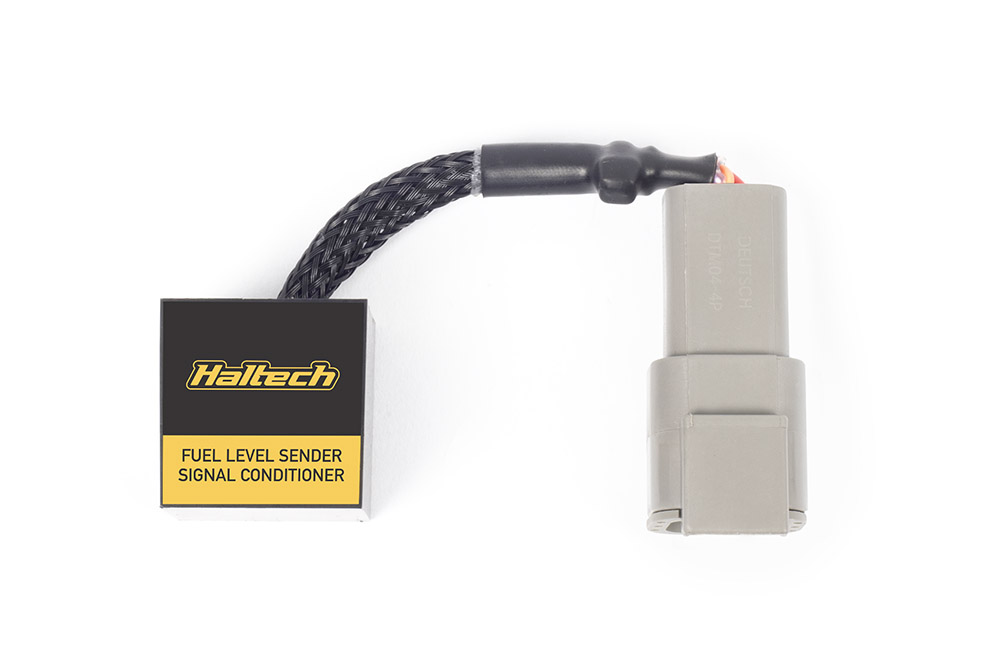
In high-performance automotive electronics, signal integrity is paramount. One of the most common issues in custom builds and standalone ECU integration is erratic or mismatched fuel level readings. Factory fuel senders operate on variable resistance, which can often be “noisy” due to fuel slosh, electrical interference, or mismatched resistance ranges between the sender and the aftermarket gauge or ECU. The Fuel Level Sender Signal Conditioner is a precision Analogue-to-Digital interface designed to filter and stabilize these resistive signals. By converting a fluctuating resistive input into a stable Analogue Voltage Input (AVI), it allows the ECU to accurately display fuel levels and implement safety features like low-fuel engine protection or logging.
The Physics of Signal Conditioning
Traditional fuel senders use a float-arm connected to a potentiometer. As the fuel level changes, the resistance across the unit varies. However, the movement of the fuel in the tank during cornering or acceleration causes the float to bounce, leading to a signal that rapidly oscillates. The Fuel Level Sender Signal Conditioner applies a sophisticated filtering algorithm to smooth these oscillations. It effectively acts as a low-pass filter, ignoring the high-frequency “noise” of fuel slosh while responding to the slow, steady change of fuel consumption. This ensures that the fuel gauge or ECU display remains steady, providing the driver with reliable data. This is a critical component for LS-swap or 2JZ projects where a custom fuel cell or an older fuel tank is being interfaced with a modern digital dashboard.
Operational Benefits for High-Performance Systems
Beyond aesthetics, accurate fuel level data is a vital safety metric. In modern fuel map calibration, knowing the exact fuel level allows the tuner to set Fuel Pressure Safety thresholds. If the fuel level is low and the fuel pump begins to cavitate during high-G maneuvers, the ECU can detect the lean condition. However, with a conditioned signal, the ECU can also be programmed to reduce boost or limit RPM if the fuel level drops below a specific percentage, preventing lean-out events before they occur. The conditioner also enables the use of non-linear senders by allowing the ECU to map the 0-5V output to a custom calibration table, ensuring that “Half Tank” actually means 50% volume.
Installation and Integration Strategy
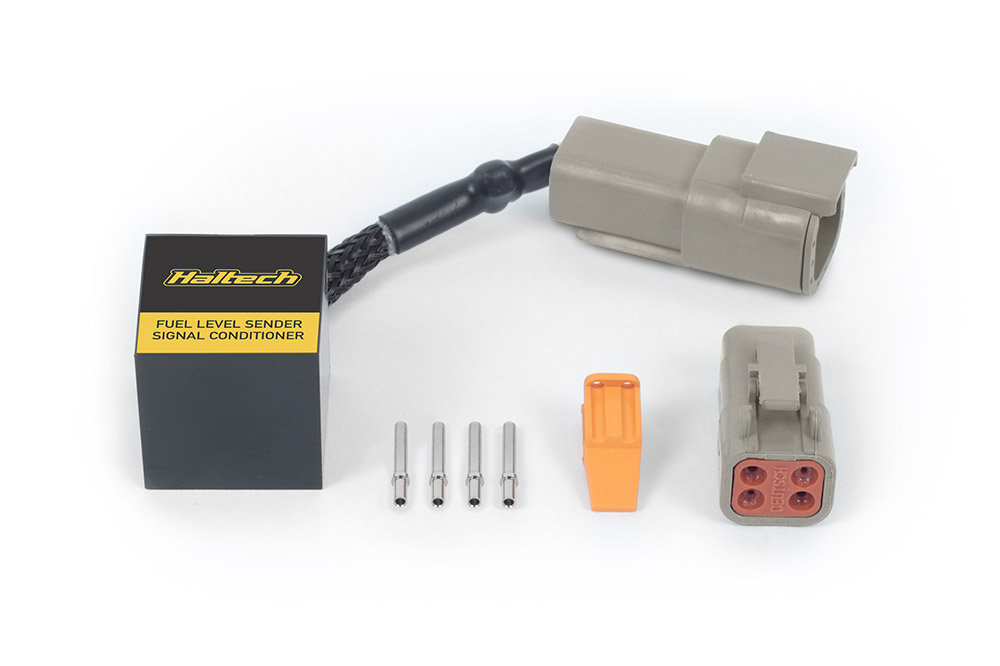
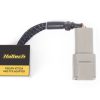
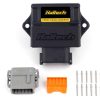
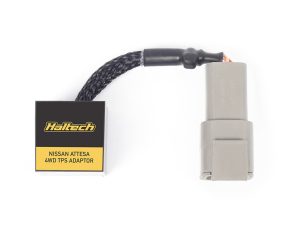
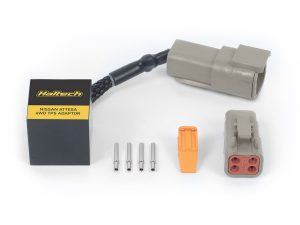
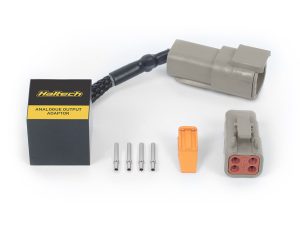
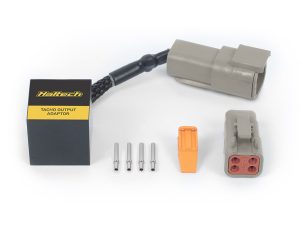
This unit is designed to be a transparent bridge between the tank and the wiring harness. It features a compact footprint and includes a high-quality Deutsch DTM 4 connector set for a Weatherproof installation. The input side receives the signal from the fuel sender (typically a 0-250 ohm or 0-90 ohm range), and the output provides a filtered 0-5V signal to the ECU’s AVI. This setup is compatible with virtually all modern engine management platforms, including Haltech Elite and Nexus. It is especially recommended for race cars with fuel cells where high-G slosh makes unconditioned signals unusable.
Technical Specifications
| Parameter | Specification |
|---|---|
| Input Signal Type | Resistive (Variable Ohms) |
| Output Signal Type | 0-5V Analogue Voltage |
| Filtering Logic | Adaptive Low-Pass Smoothing |
| Connector Series | Deutsch DTM 4-Pin |
| ECU Compatibility | Elite, Nexus, and any ECU with 0-5V AVI |
| Enclosure Rating | Automotive Grade / Moisture Resistant |
Summary & Includes
The Fuel Level Sender Signal Conditioner is the definitive solution for jittery fuel gauges and inaccurate data logging. Includes: 1 x Signal Conditioner and HT-031016 (Matching set of Deutsch DTM 4 Connectors). Note: Essential for race applications and custom fuel cell integrations.
Reviews
There are no reviews yet.