
No products in the cart.
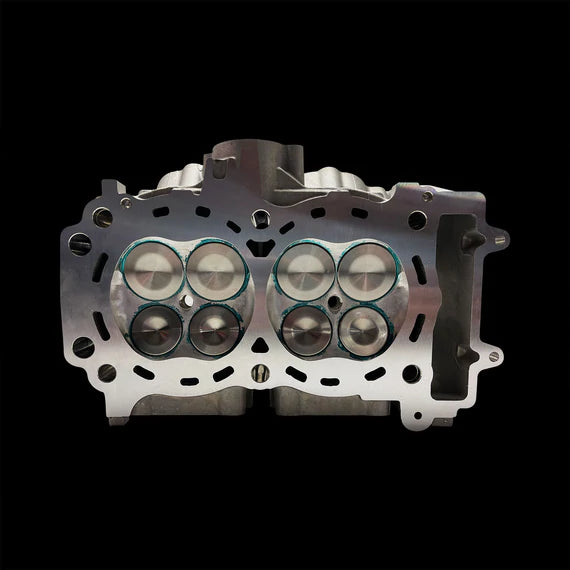
In the relentless pursuit of horsepower and reliability for the Polaris Pro XP Turbo, the cylinder head represents the final, critical bottleneck. Factory casting limitations, inconsistent port geometry, and valvetrain flex under boost are the hidden adversaries of peak performance. The BC9911 Polaris XP Turbo CNC Cylinder Head from Brian Crower is not a modified OEM piece; it is a purpose-built, billet-aluminum foundation engineered from the ground up to eradicate these limitations. Utilizing aerospace-grade 356-T6 aluminum and machined on a 5-axis CNC to tolerances measured in ten-thousandths of an inch, the BC9911 transforms the engine’s breathing architecture. Its defining feature, the massive Big Port 38.8mm intake and 33mm exhaust valves, works in concert with fully optimized port and combustion chamber designs to support extreme horsepower targets while maintaining precise combustion control. This component is the definitive upgrade for builders who understand that true power is not just added, but engineered—flowing from a head that matches the potential of today’s advanced turbo systems and fueling strategies.
CNC Precision & Aerospace Material Science
The cornerstone of the BC9911’s dominance is its manufacturing integrity. Starting with a solid billet of 356-T6 aluminum ensures a homogeneous material structure free from the potential porosity and inconsistency of castings. This billet is then subjected to a meticulous 5-axis CNC machining process. Unlike 3-axis machining, 5-axis control allows the cutting tool to approach the workpiece from any direction, enabling the creation of the complex, flowing contours of the intake and exhaust ports with unmatched accuracy and surface finish. Every runner is digitally mapped and identically reproduced, guaranteeing cylinder-to-cylinder consistency that is physically impossible with hand-ported heads. The combustion chambers are not just enlarged but scientifically reshaped to promote optimal flame front propagation and quench, critical for preventing detonation under high boost. This level of precision directly translates to predictable, repeatable performance gains and a robust platform for tuning.
Optimizing Combustion & Volumetric Efficiency
Volumetric efficiency (VE) is the measure of how completely an engine fills its cylinders with air. The BC9911’s architecture is a masterclass in maximizing VE. The Big Port design significantly increases cross-sectional area at the valve seat, but the genius lies in the port’s velocity stack shape. The runners are designed to maintain high air velocity at low RPM for strong throttle response, then progressively open up to minimize restriction at high RPM and peak boost, where flow demand is greatest. This results in a broader, flatter torque curve. The reshaped combustion chamber lowers the static compression ratio in a controlled manner to accommodate increased boost pressure, while its geometry works to create a more efficient, controlled burn. This reduces exhaust gas temperatures (EGT) and thermal stress on the piston crown—a critical factor in turbocharged endurance applications. For an in-depth exploration of how port geometry influences power bands, consider this resource on cylinder head port design fundamentals.
The Valvetrain: Foundation for High-RPM, High-Boost Stability
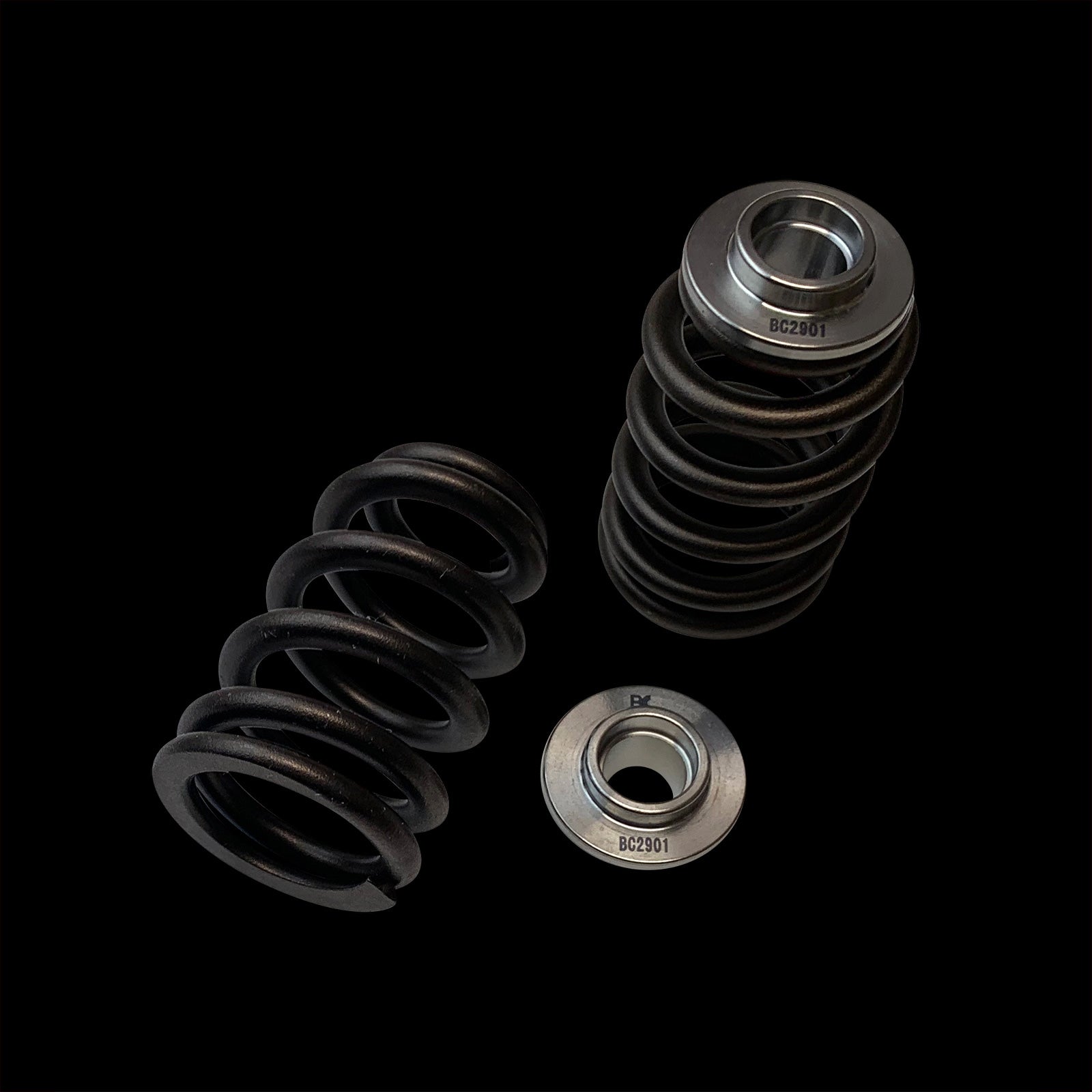
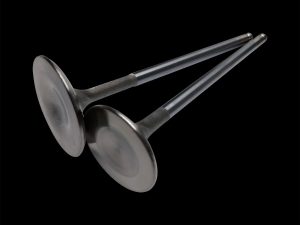
Larger valves are meaningless without a valvetrain capable of controlling them at elevated engine speeds. The BC9911 is equipped with oversized, bronze-alloy valve guides that provide superior heat dissipation and wear characteristics compared to powdered metal OEM guides. The valves themselves—huge 38.8mm intake and 33mm exhaust units—are crafted from high-strength, heat-resistant alloy and feature undercut stems to reduce weight and inertia. They are secured by Brian Crower’s premium, precision-ground lock kits. This entire assembly is designed to interface with upgraded springs and retainers (often recommended and sold separately) to prevent valve float, the condition where the valvetrain can no longer follow the cam profile, leading to a catastrophic loss of power and potential engine damage. The stability provided here ensures that the airflow gains from the port work are fully realized across the entire usable RPM range, even under 30+ PSI of boost.
Direct Benefits & Performance Outcomes
- Substantial Horsepower & Torque Gains: Unlocks 40+ horsepower over stock with proper supporting modifications (turbo, fuel, tune) by dramatically reducing intake and exhaust restriction.
- Broadened Power Band: Optimized port velocity maintains low-end and mid-range torque while supporting massive top-end airflow, flattening and extending the torque curve.
- Enhanced Thermal Management: Superior aluminum alloy and efficient combustion chamber design lower peak cylinder temperatures, reducing the risk of detonation and piston failure.
- Unmatched Consistency: CNC machining guarantees each cylinder flows identically, leading to smoother engine operation, more stable tuning parameters, and balanced cylinder pressures.
- Foundational for Big Power: This head is a prerequisite for builds aiming for 250+ HP, providing the airflow capacity necessary for larger turbos and aggressive ethanol-based fueling.
- Increased Engine Safety Margin: By lowering EGTs and improving combustion control, it reduces stress on pistons, rings, and rods, directly contributing to long-term reliability.
Vehicle Fitment & Installation Protocol
Vehicle Fitment: This BC9911 CNC Cylinder Head is engineered specifically for the 2020-2023 Polaris Pro XP Turbo (925cc) and RZR Pro XP Turbo models. It is a direct replacement for the OEM cylinder head. Critical Note: This is a bare head assembly. It includes the machined head, 38.8mm intake valves, 33mm exhaust valves, valve guides, seals, and spring locators. It does NOT include valve springs, retainers, camshafts, or head bolts/studs. For any performance build, especially one leveraging this head’s capability, upgrading to a high-lift camshaft kit and heavy-duty valve springs & retainers from Brian Crower or an equivalent manufacturer is mandatory to prevent valvetrain failure.
Installation requires a high level of mechanical competency. The procedure involves complete disassembly of the top end, careful cleaning of all mating surfaces, and precise measurement of valve lash (clearance) after assembly with your chosen camshafts. The use of a high-quality torque wrench and adherence to the proper head bolt/stud torque sequence and specification is non-negotiable to prevent warpage or gasket failure. Consultation of the appropriate service manual is essential.
Technical Specifications
| Part Number | BC9911 |
| Primary Application | 2020-2023 Polaris Pro XP Turbo / RZR Pro XP Turbo (925cc) |
| Material | 356-T6 Aluminum Billet |
| Manufacturing Process | 5-Axis CNC Machined |
| Intake Valve Diameter | 38.8mm (Big Port) |
| Exhaust Valve Diameter | 33.0mm |
| Valve Guides | Bronze Alloy, Oversized |
| Included Components | Bare Head, Valves, Guides, Seals, Spring Locators, Valve Locks |
| Required Supporting Parts | Valve Springs, Retainers, Camshafts, Head Studs, Head Gasket (Not Included) |
The Brian Crower BC9911 is the definitive solution for the serious Pro XP Turbo builder. It transcends the category of a simple “upgrade” and establishes itself as a core engineering component for any high-horsepower or endurance-focused build. By addressing the fundamental limitations of the factory head with precision manufacturing and intelligent design, it provides the airflow, thermal management, and valvetrain stability required to harness the full potential of modern forced induction. This is not about incremental gains; it is about building a foundation for dominant, reliable power.
Be the first to review “BC9911 – Polaris XP Turbo CNC Cylinder Head – Big Port 38.8mm/33mm Valves”
| Make | Model | Year |
|---|---|---|
| Polaris | RZR Pro-R | 2021 |
Related products
Reviews
There are no reviews yet.